Experience vs Experiences: Which Is Correct? Meaning, Grammar and Examples
Experience vs experiences looks like a plain singular-and-plural question, but it isn’t. One word does two jobs: it can name what you know (“ten years of experience”) or what happened to you (“a rough experience”). Pick the wrong job and the sentence sounds off, even though every word is spelled correctly.
Quick answer: Experience is uncountable when it means skill or knowledge gained over time (“five years of experience”). It is countable when it means something that happened to you (“a bad experience”, “two experiences”). Use experiences only for separate events or encounters, and never put a/an or many before the skill sense.
Experience or experiences? A two-second test
Much of the confusion clears up if you ask one question: am I talking about a total amount, or about separate episodes?
- Total amount (what you know because of what you’ve done): use experience, with no -s, no a/an, and much or a lot of.
- Separate episodes (things that happened, which you could list): use an experience or experiences, and you can count them.
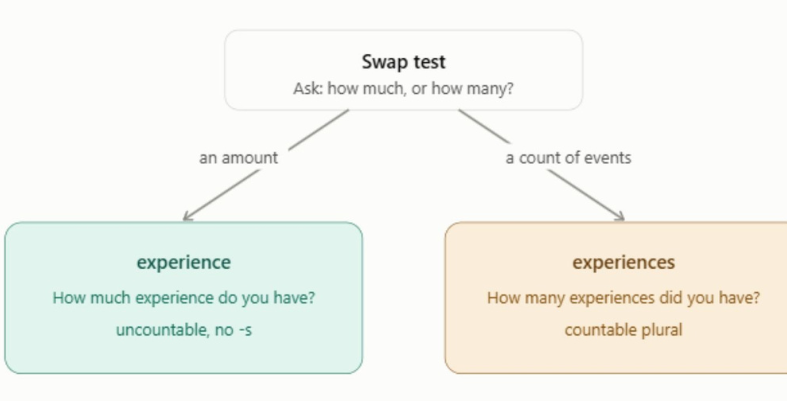
Try the swap test. Ask “how much?” or “how many?”. “How much experience do you have?” asks for an amount, so you want the uncountable form. “How many experiences did you have?” asks you to count events, so you want the plural.
| What you mean | Form | Example |
| General skill, background, know-how | experience | She has a lot of experience in nursing. |
| One event | an experience | Getting lost in Lisbon was quite an experience. |
| Several events | experiences | Both experiences made him rethink how he travels. |
What does experience mean? Three senses explained
Experience is one spelling with three working meanings. The grammar changes with each one, and dictionaries often list them as separate senses.
1. Skill or knowledge gained over time (uncountable)
Think of this sense as money in a bank account, not coins in a jar. You don’t count it in pieces. You have more or less of it. That is why you say a lot of experience and little experience, and why it takes a singular verb.
Dana has six years of experience in logistics. We learn a lot from experience.
2. Something that happens to you (countable)
Here the word is a plain event: a trip, a meeting, a bad meal. You can number these, so an experience, three experiences and many experiences are all fine. The event is often one that affects you or teaches you something. That meal was an experience can suggest that it was memorable, for good or bad reasons.
Camping in the rain was an experience I’d rather not repeat.
3. A designed or packaged experience (usually countable, but flexible)
Business English uses experience for what a customer or user goes through with a product or service. The user experience and the customer experience are singular and general: the overall quality of using something. Experience gifts and two experiences from the catalogue are packaged activities you can buy and count.
Experience as a verb
To experience something is to go through it or feel it. It takes an object: Passengers may experience delays. The forms are experience, experiences, experienced, experiencing. Careful: experiences can be a verb in the third person (“she experiences headaches”) as well as the plural noun, so check the sentence.
Related words
Experienced (adjective): having skill from doing something. Inexperience (noun): lack of that skill. Experiential (adjective): relating to or learned through experience.
How to pronounce experience and experiences
- IPA, UK: /ɪkˈspɪəriəns/
- IPA, US: /ɪkˈspɪriəns/
- Simple spelling: ik-SPEEL-ee-unss
- Stress: the second syllable, “SPEER”. It rhymes with peer, not with spare.
The plural adds one syllable: ik-SPEER-ee-un-siz, /ɪkˈspɪəriənsɪz/]. Some learners say the plural like the singular, so if your listener can’t tell experience from experiences, the final “siz” is the part to practise.
Part of speech and word forms
| Form | Part of speech | Notes |
| experience | noun (uncountable) | skill or knowledge over time |
| an experience / experiences | noun (countable) | events |
| experience, experiences, experienced, experiencing | verb (transitive) | to go through or feel something |
| experienced | adjective | an experienced pilot |

Countable or uncountable? The grammar
Much, many, a/an: quantifiers and determiners
| Skill sense (uncountable) | Event sense (countable) |
| much, little | many, few, a few, several, a number of |
| less | fewer |
| this | these |
| no a/an, no numbers | a/an, numbers |
She has little experience with legal writing. She has had few experiences like it.
A lot of, some, any, no and plenty of work with both senses: a lot of experience and a lot of experiences are both fine. The words in the table are the ones that give the sense away.
Counting the skill sense. You can’t count experience itself when it means skill, so count what it is made of: three years of experience, experience in two industries, experience with four programming languages. Writing three experiences in those sentences would change the meaning to three separate events.
Verb agreement
The uncountable noun takes a singular verb: Experience matters more than a degree for this role. The plural noun takes a plural verb: Her experiences abroad were very different from each other.
Experience in, of, with: prepositions
These are tendencies, not strict rules, and speakers sometimes use them interchangeably. experience in field or job: experience in sales, experience in primary teaching.
- experience with + tool, product or type of person: experience with Excel, experience with young children.
- experience of + event or gerund: experience of living abroad.
- experience at + place: experience at a large hospital.
Fixed phrases: in my experience (introduces an opinion based on what you’ve seen), from experience (I know from experience that the train is late on Fridays), first-hand experience, hands-on experience. After “based on my / his / her”, writers usually use the uncountable form: Based on my experience, I’d choose the smaller team.
The saying “experience is the best teacher” is singular and uncountable. Don’t write “experiences are the best teacher”.
Borderline phrases, ruled one by one
Some phrases take either form. The rule underneath is always the same: singular means a total or a background; plural means separate episodes or accounts. These rulings are my reading, so check them against a corpus .
| Phrase | Singular when… | Plural when… |
| wartime experience(s) | you mean what he knows because of it | you mean specific events, as in a memoir |
| personal experience(s) | opening an opinion: “in my personal experience” | sharing stories: “she shared her personal experiences” |
| teaching experience(s) | measuring years: “five years of teaching experience” | telling episodes: “my teaching experiences in rural schools” |
| work experience(s) | listing your background (the normal CV form) | contrasting separate placements in a study or essay |
| lived experience(s) | the general idea of first-hand life | accounts from different individuals |
Other nouns that switch the same way
Experience is not the only noun that does this. Here are four familiar pairs, with experience at the bottom for comparison.
| Uncountable: the material or amount | Countable: one item or instance |
| I need more paper for the printer. | She published a paper on soil erosion. |
| There was a lot of noise outside. | I heard a noise downstairs. |
| Is there room for one more? | She booked a room for two nights. |
| He has thick grey hair. | There’s a hair in my soup. |
| She has ten years of experience. | That trip was quite an experience. |
In each pair, the uncountable noun is the material or the amount, and the countable noun is one instance of it. That is the whole logic behind experience: skill is the material, and an event is one instance.
Which form to use: CV, essay, review or chat
- CVs and job ads: experience, singular. “Relevant experience”, “five years’ experience”, “proven experience in…”. The usual heading is “Work Experience”.
- Academic writing: experiences for participants’ accounts (“participants described their experiences of…”), experience for the general concept.
- Reviews and marketing: the customer experience for overall quality; guests’ experiences for individual stories.
- Casual speech: That was some experience! for an event; I’ve got loads of experience for skill.
Example sentences
| Context | Sentence |
| Formal, job ad | Candidates should have at least three years of experience in clinical research. |
| Formal, report | Respondents described their experiences of the new booking system as mixed. |
| Casual, spoken | I don’t have much experience with sewing machines, so go easy on me. |
| Casual, event | Honestly, camping in the rain was an experience I’d rather not repeat. |
| Written, blog | The three experiences that changed how I budget all happened before I turned thirty. |
| Thank you for your feedback, and we’re sorry your experience at our branch fell short. | |
| Opinion | In my experience, deadlines slip when nobody owns them. |
| Verb | Passengers may experience short delays during the repair work. |
| Idiom | Mistakes are a good experience as long as you write down what went wrong. |
| Academic | Her lived experience of long-term illness shaped the study’s questions. |
Synonyms for experience, and how they differ
Synonyms depend on the sense, so they are grouped by meaning.
For an event that happened to you
- Incident: a notable event, often unpleasant or needing a report. Sounds official.
- Episode: one part of a longer run of events. Use it when the story has chapters.
- Ordeal: a painful, difficult experience that tests you.
- Adventure: exciting and a little risky, usually something you chose.
- Encounter: a meeting with a person, animal or problem.
- Occurrence: a neutral, distant word that says something happened, not how it felt.
For skill or knowledge gained over time
- Expertise: deep specialist skill, usually recognised by others.
- Background: the history of your study and work, not your skill level.
- Know-how: informal, practical, hands-on ability.
- Track record: documented results from past work. Proof, not just time served.
- Proficiency: a skill level you can measure, as in language tests.
- Familiarity: some knowledge from contact, short of mastery.
For the verb to experience
- Undergo: formal, and usually something hard or medical.
- Go through: informal, and usually something difficult.
- Live through: you survived something severe.
- Encounter: you meet it, often a problem.
- Feel: emotions and sensations only.
Antonyms and contrast words
There is no true opposite for the event sense. For the skill sense:
- Inexperience: the lack itself. Her inexperience showed in the first week.
- Ignorance: not knowing, whatever the reason. Ignorance of the rules is no defence.
- Naivety: a trusting outlook that comes from not having been tested. His naivety about money cost him.
- Theory (as a contrast): knowing how something works on paper. She knows the theory but lacks experience.
- Novice (a person): someone new to a field, the opposite of an experienced person.
Word origin
The word reached English in the late 1300s from Old French esperience, which meant experiment, proof or experience. French took it from Latin experientia, meaning a trial or knowledge gained by repeated trying. That comes from the verb experiri, “to try, to test”. Etymonline traces it further back to an ancient root meaning “to risk” . Experiment comes from the same Latin verb, which is why the two words look related.
The earliest English senses were close to learning by observation and to an event that had affected someone. Etymonline dates the skill sense, being practised at something and getting good at it, to the late 1400s, and the verb to the 1530s .
Common mistakes with experience and experiences
| Mistake | Correct | Why |
| I have a lot of experience in design. | I have a lot of experience in design. | Skill is uncountable, so use much or a lot of. |
| I have experience in Python. | I have experience in Python. | The skill sense takes no a/an. (“I had an experience in Python” would be an event.) |
| Five years of experiences | Five years of experience | “Years of” measures an amount. |
| This experience was useful. | This experience was useful. / These experiences were useful. | The noun and the determiner must agree in number. |
| I experienced nerves before exams. | I experience nerves before exams. | The verb takes -s after he, she, it or a singular noun, never after I. |
| Experiences are the best teacher. | Experience is the best teacher. | The set expression is singular. |
| less experiences | fewer experiences (events) / less experience (skill) | Fewer goes with countable nouns. |
| I had an experience in the lab. | I did an experiment in the lab. | Experience and experiment are different words, even though they share a root. |
Why learners get this wrong
In English, skill is a mass idea and events are countable, and the grammar follows. In French, the same distinction shows up as une expérience (an experience, or an experiment) against de l’expérience (experience as skill). A French speaker who sees une expérience may write an experience for both. I have only checked French, so add any other language only after a native speaker has reviewed it
FAQs
Is it “experience” or “experiences”?
Both are correct, for different meanings. Use experience, with no -s, for skill or knowledge built up over time: “ten years of experience”. Use experiences for separate events that happened to you: “my first two experiences abroad”. If you can count the items, add the -s; if you mean a general amount, don’t.
Is experience a countable or uncountable noun?
Both. As skill or knowledge gained over time, it is uncountable: you say a lot of experience, not an experience or two experiences. As an event that happened to you, it is countable: an experience, two experiences, many experiences. Check which meaning your sentence has before choosing.
Should I write “experience” or “experiences” on a CV?
On a CV, use experience without an -s for your overall background: “relevant experience”, “five years’ experience”. Use experiences only when you describe separate episodes, such as “my experiences volunteering abroad”, for example in a personal statement or essay. The usual heading is “Work Experience”.
What is the difference between “experience in”, “experience of” and “experience with”?
Experience usually names a field or job: “experience in sales”. Experience usually names a tool, product or kind of client: “experience with Excel”. Experience often precedes a gerund or a life event: “experience of living abroad”. The lines are soft, and speakers sometimes swap them.
Is “good experience” or “a good experience” correct?
Both are correct, and the article changes the meaning. “A good experience” is a pleasant event: “the hotel stay was a good experience”. “Good experience” with no article usually means something useful for your learning or career: “the internship was good experience”. The second treats experience as uncountable.
Final Thoughts
Experience vs experiences is less about singular and plural and more about which job the word is doing. If you mean skill or knowledge built up over time, use experience: no -s, no a/an, and much or a lot of. If you mean separate events you could list or count, use an experience or experiences.
When you’re unsure, ask “how much?” or “how many?”. If the answer is an amount, keep it uncountable. If the answer is a number of episodes, add the -s. On a CV, “five years of experience” is almost always right, while “my experiences volunteering abroad” belongs in a story or essay. Check the meaning first, and the grammar follows.